How I Choose SaaS Apps I'll Actually Pay For Now
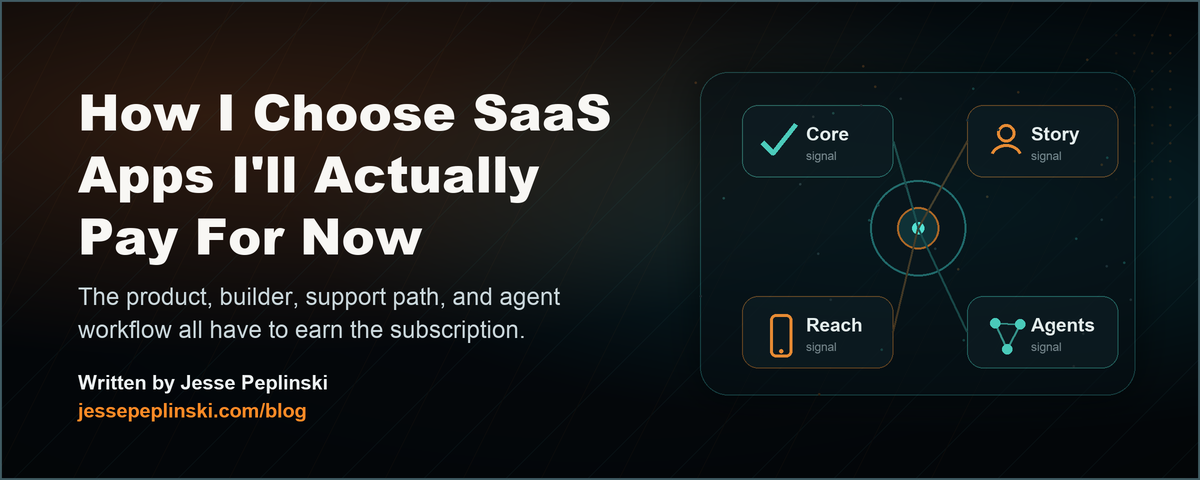
The filter I use before paying for a SaaS product now: a core feature that works, a believable builder story, reachable human support, and a product that is ready for AI agents.
It is getting harder to decide which SaaS products are worth paying for.
Not because there are not enough options.
Because there are too many.
Every category has a pile of tools now. A lot of them overlap. A lot of them use the same words. A lot of them have clean landing pages, AI features, nice screenshots, and pricing that looks reasonable until you start adding up all the subscriptions.
And if you are a builder, there is another question sitting underneath the buying decision:
Should I pay for this, or should I just build the version I need myself?
That question is more real than it used to be.
AI has made small internal tools much easier to build. If a SaaS product is just a thin wrapper around a narrow workflow, I can usually imagine a version I could roll myself. Maybe not as polished. Maybe not as reliable. But enough to make me pause before adding another monthly charge.
At the same time, I do not want my default answer to be “build everything myself.”
I still want to pay for good software. I want to support people building useful products. Especially smaller teams and founders working from the ground up. If someone is solving a real problem well, I would rather pay them than recreate the whole thing just to save a few dollars a month.
But my bar has changed.
This is the filter I am using now.
The core feature has to actually work
I do not need thirty features.
I need one or two that work really well.
That sounds obvious, but it is where a lot of products start to lose me. The homepage shows a huge feature grid. The product has dashboards, assistants, automations, integrations, templates, exports, analytics, collaboration, and a roadmap full of things that sound useful.
Then you try the core workflow and it is only half there.
I understand why that happens. This is a weird moment to build software. Everyone is trying to figure out what AI changes, what customers actually want, what workflows are worth owning, and what parts of the product should be automated. There is a lot of pressure to show momentum.
But as a buyer, I am not paying for momentum.
I am paying for a result.
If a product is a content tool, it needs to help me create good content. If it is a scheduling tool, the scheduling flow needs to be clean. If it is an analytics tool, the numbers need to be trustworthy. If it is a support tool, it needs to help me support users faster.
The core promise has to work.
That is the first test.
For Postede, this is the standard I keep coming back to internally. If the product does not help someone create useful launch content and get it into the right channel, then the rest of the product does not matter yet. We can add more surfaces, more settings, more automations, and more polish later. But the central workflow has to earn trust first.
That is true for almost every SaaS product I evaluate now.
I am much more willing to pay for a small product that does one painful thing well than a bigger product that seems impressive but does not nail the main job.
I need to understand the story
When I pay for a SaaS product, I am not only buying the current feature set.
I am buying the judgment behind it.
That has become a much bigger part of the decision for me. I want to know who built it. I want to know why they built it. I want to know whether they actually understand the problem or whether they are chasing a category because the market looks hot.
This is not about needing a dramatic founder story.
It is about trust.
Every product decision is a trust decision. Pricing is trust. Roadmap is trust. Support is trust. Data handling is trust. AI behavior is trust. Even the small UI decisions tell me something about how the builder thinks.
If I am going to put a product into my workflow, I need to believe the person or team behind it will make good decisions on behalf of the product.
That means I look for signals:
- Do they explain the problem plainly?
- Do they seem close to the workflow?
- Do they show their thinking?
- Do they have a point of view beyond “AI-powered everything”?
- Do they make tradeoffs I understand?
The more crowded the market gets, the more this matters.
A generic product can still be useful. But when five products seem to do roughly the same thing, the builder story becomes part of the product. It helps me decide whether this is something I want to bet on.
I wrote before that the next wave of SaaS is trust. I still believe that. The difference here is that I am applying it as a buyer, not just as a builder.
If I cannot understand why the product exists, who is behind it, and why I should trust their judgment, I am much less likely to pay.
I want a real person within reach
Support matters more to me now.
Especially for early SaaS products.
If a product is large and established, I understand that I may not be calling someone directly. There may be a help center, ticket system, account manager, community forum, or some other support layer. That is normal.
But for smaller products, I want the human path to be obvious.
Can I contact the founder?
Can I email a real person?
Can I call or text someone if something goes sideways?
Can I get a response that feels like the person actually understands the product?
The dream version is simple: there is a number on the contact page, and if I call it, a real person can pick up in three rings or less.
That does not mean every founder needs to run a 24/7 phone line forever. That does not scale, and I get that. But early on, accessibility is a feature. If you are asking people to trust a young product with real work, being reachable is part of the deal.
I think this is underrated.
For a buyer, it changes the risk calculation. If I know I can reach a real person, I am more willing to try the product. I am more willing to forgive a rough edge. I am more willing to pay early, give feedback, and stick around while the product improves.
That is also the standard I want to hold myself to. On Postede, the early users should be able to get close to the people building it. That is not a marketing trick. It is how you learn what is working, what is confusing, and where the product is missing the real job.
The worst version of early SaaS is a product that feels both unfinished and unreachable.
If the product is young, I need to see the humans.
It has to be ready for AI workflows
The last filter is newer, but it matters a lot.
The product has to be AI-first, or at least AI-ready.
I do not mean it needs a chat bubble pasted into the UI. I do not mean every feature needs to generate something. I do not mean it needs to call itself an agent platform.
I mean the product has to understand where work is going.
People are going to live more of their day inside AI tools. Codex, Claude, ChatGPT, internal agents, voice workflows, local scripts, and automation layers are becoming part of how real work gets done. That means a SaaS product cannot assume the only user is a human clicking around a dashboard.
I want to know whether the product can participate in that workflow.
Does it have a good API?
Does it have a CLI?
Does it have webhooks?
Does it have clean docs?
Could an MCP server make sense?
Could a Codex plugin, Claude integration, or agent-readable workflow exist someday?
The product does not need all of that on day one. But the direction matters.
If a product is closed off, manual, and hard to automate, it starts to feel fragile. Maybe I still use it because it solves an immediate problem. But I am less excited to build a long-term workflow around it.
I wrote more about this in The SaaS Companies That Win Will Be Agent-Ready. My buying behavior is starting to match that belief.
If I am choosing between two products and one of them is clearly thinking about agents, APIs, automation, and AI-native workflows, that product has a real advantage.
Not because AI is a badge.
Because my workflow is changing.
This is the bar now
So the filter is pretty simple:
- Does the core feature work well enough that I am delighted to use it?
- Do I understand the story and trust the builder’s judgment?
- Can I reach a real person if I need help?
- Is the product ready for AI-first workflows?
That does not mean every product has to be perfect.
I will still pay for rough products if the core is strong and the builder seems trustworthy. I will still try early tools if the direction is right. I will still support small teams if I believe they are solving a real problem and listening to users.
But I am less willing to pay for vague software now.
I am less interested in feature sprawl.
I am less impressed by polish without substance.
I am less willing to adopt tools that feel closed off from the way work is moving.
The products I want to pay for now are the ones that do something real, explain why they exist, make humans reachable, and fit into an AI-assisted workflow.
That is the bar I am using as a buyer.
It is also the bar I want to keep using as a builder.